Blue Spotted Sting Ray
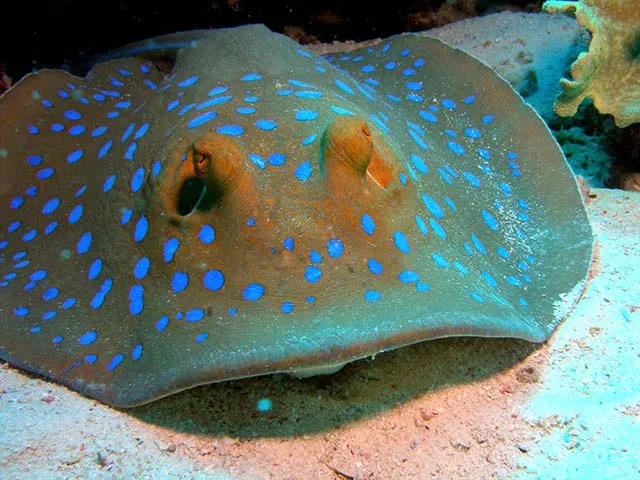
Everyone loves a blue spotted stingray. They are beautiful to watch and look so elegant when swimming or moving along the seabed. Their vivid blue spots are a lovely sight when diving in Hurghada. The colours you see underwater depend on the depth, light and conditions.
Their bodies are oval-shaped discs with blue stripes along their tails. They have venomous spines on the tail, used for defence if threatened or stepped on. Their skeletons are made of flexible cartilage, the same type of tissue found in our ears. Although they look different, rays are related to sharks.
These are small rays, with a disc roughly 30–35 cm across.
Their eyes are on top of their bodies, with openings called spiracles just behind them. Water enters through the spiracles and passes out through the gills underneath, helping them breathe while resting on the seabed.
They swim by flapping their fins in the same way a bird flaps their wings.
The tail spines are used for protection. Give rays plenty of space and never try to touch or handle them.
The scientific name is Taeniura lymma. In the Red Sea, we know them as blue spotted stingrays, but they are also called bluespotted ribbontail rays or lagoon rays.
Their lifespan is not well established, so it is best not to put a fixed age on these lovely animals.
They live around shallow coral reefs and sandy bottoms and are a familiar sight in the Red Sea. They often shelter beneath ledges rather than burying themselves in sand. Like all marine life, they should be left undisturbed. Keep good buoyancy, watch where you place your feet and never touch a ray. If a sting occurs, alert your guide and seek prompt medical attention.
These rays give birth to live young rather than laying eggs. A litter can contain up to seven pups, already bearing blue spots. Male rays have claspers on their pelvic fins, used during mating.
Stingrays have electrical sensors and mouths underneath their bodies, helping them locate food on the seabed. Their small teeth are arranged in plates for crushing prey. They eat small fish and invertebrates such as crabs, shrimps and molluscs.
Large predators, including hammerhead sharks, may prey on these rays. Human pressures include fishing, habitat damage and collection for aquariums. Protecting reefs and watching wildlife responsibly helps preserve the places where they live.
As mentioned above, blue spotted stingrays are a familiar sight here in Hurghada. If you are not under the blues of the Red Sea, you are missing the blues on these beautiful rays! Get in touch with Dive UK Hurghada by WhatsApp or email and we can help plan your diving. Sightings are always a matter of luck.